
Every year, Class 12 PCB students and parents in Nagpur and across Vidarbha hear different versions of the NMC rules. One consultant says “five years is enough.” Another says “any six-year course works.” Both can be wrong. This guide explains the NMC guidelines for MBBS abroad 2026 in plain language: NEET, the 54+12 rule, internship, FMGE vs NExT and online study. Quick answer: to be eligible in India later, you need NEET, at least 54 months of study plus a separate 12-month internship, all at the same foreign institution, in English, with real clinical training.
Quick Summary: NMC Conditions for New Applicants
| Condition | What it means for you |
|---|---|
| NEET | Mandatory for Indian citizens and OCI cardholders |
| Course duration | At least 54 months of study |
| Internship | A separate 12-month internship (the “+12”) |
| Institution and country | Same university and same country for the whole programme |
| Medium of instruction | English |
| Clinical training | Hands-on training in a teaching hospital |
| Host-country licence | Graduate must be eligible for the licence local graduates receive |
| Indian internship | Supervised CRMI in India, as per NMC rules |
| Screening exam | FMGE is the operational exam in 2026 |
| Study mode | Physical, in-person study; avoid online or hybrid programmes |
What Are the NMC Rules for MBBS Abroad in 2026?
The main framework is still the Foreign Medical Graduate Licentiate (FMGL) Regulations 2021. These regulations set the conditions a foreign medical degree must meet for an Indian student to be eligible for the screening test and registration in India.
You may have seen news about “new NMC rules” in 2026. Most of those notices concerned existing students whose studies were affected by online classes. They were not a new rulebook for fresh admissions. If you are applying now, the FMGL Regulations 2021 remain your main reference.
Rules can be updated, so always check the latest notices on the NMC rules page before you pay any fee.
NEET Requirement for MBBS Abroad
NEET is mandatory for Indian citizens and OCI cardholders who want to study MBBS abroad and later practise in India. Your NEET qualifying result is valid for 3 years.
Many parents worry that a low score closes every door. It does not always, but you should understand your options honestly. Read our guide on MBBS abroad with a low NEET score before deciding.
Be careful of anyone who says “no NEET needed.” Some universities may admit you without it, but that does not change the NMC requirement for returning to practise in India.
The 54+12 Rule Explained
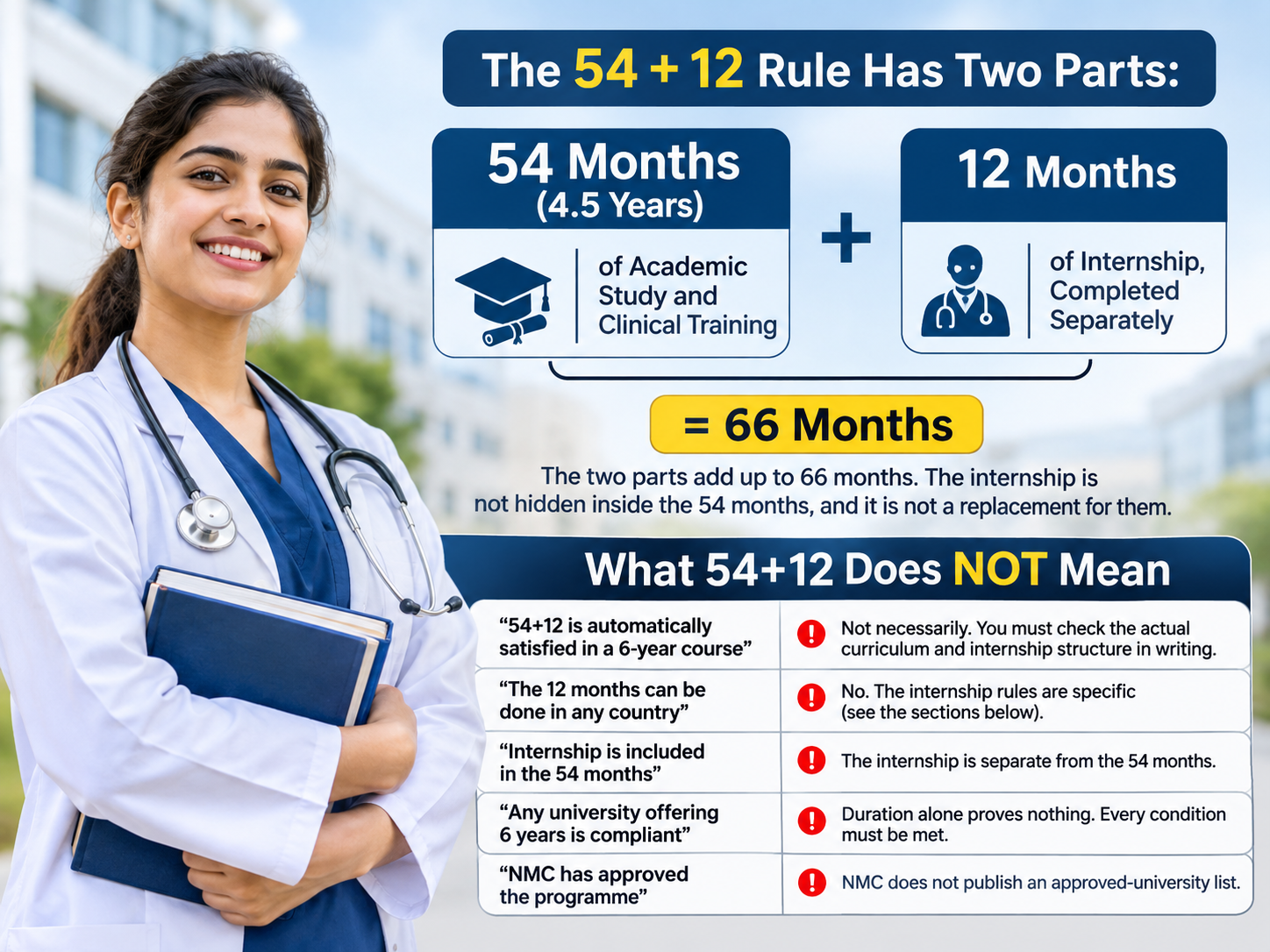
The 54+12 rule has two parts:
- 54 months (4.5 years) of academic study and clinical training
- 12 months of internship, completed separately
The two parts add up to 66 months. The internship is not hidden inside the 54 months, and it is not a replacement for them.
What 54+12 Does NOT Mean
| Common claim | Why it is a problem |
|---|---|
| “54+12 is automatically satisfied in a 6-year course” | Not necessarily. You must check the actual curriculum and internship structure in writing. |
| “The 12 months can be done in any country” | No. The internship rules are specific (see the sections below). |
| “Internship is included in the 54 months” | The internship is separate from the 54 months. |
| “Any university offering 6 years is compliant” | Duration alone proves nothing. Every condition must be met. |
| “NMC has approved the programme” | NMC does not publish an approved-university list. |
Examples of Advertised Course Structures
| Advertised structure | Risk level | What to ask |
|---|---|---|
| “5 years including internship” | High risk | Does the study part reach 54 months, with a separate 12-month internship? |
| “6 years: 5 years study + 1 year internship” | Check carefully | Is the internship at the same institution and country? Is it a licensed, supervised internship? |
| “6 years, internship in India” | High risk | A foreign internship is expected. Indian CRMI does not replace it. |
| “4 years here, 2 years in another country” | High risk | Split programmes are not acceptable (see the next section). |
| “Hybrid: online first, offline later” | High risk | New students should avoid online or hybrid medical programmes. |
If a consultant cannot show the structure in the university’s own official document, treat it as unverified.
Same Institution and Same Country Rule
NMC expects your entire programme to follow a clear pattern:
- No transfers. Moving from one university to another midway can put your eligibility at risk.
- No split programmes. Studying part of the course in one country and part in another is not acceptable.
- No third-country internship. The foreign internship should happen in the same country where you studied.
- No Indian internship replacing the foreign one. The Indian CRMI comes after the foreign internship. It cannot take its place.
Ask the consultant one direct question: “Will my entire course and internship happen at the same institution in the same country?” Get the answer in writing.
English-Medium Instruction and Mandatory Subjects
The course should be taught and assessed in English. A programme that teaches in the local language, with only a few “English support” classes, is a concern.
The curriculum must also cover the mandatory subjects of a full MBBS course, including pre-clinical, para-clinical and clinical subjects. Ask for the full subject list and year-wise schedule from the university. If the curriculum is vague or missing, that is a warning sign. For exact subject requirements, check the latest NMC notice.
Hands-On Clinical Training and Teaching Hospital Requirements
Medicine cannot be learned only from slides and videos. NMC expects real, hands-on clinical training. Before admission, verify:
- Does the university have its own teaching hospital, or a formal tie-up with one?
- How many hours will you spend with real patients, and from which year?
- Is clinical teaching in English, or will you need the local language to talk to patients?
- Is the hospital within a practical distance of the campus?
Ask to speak with current Indian students, and ask what their clinical rotations actually look like. A beautiful campus brochure is not proof of clinical exposure.
Host-Country Licensing Eligibility
Here is a rule many parents miss. As a graduate, you should be eligible for the same licence that local graduates of that country receive. A degree that is “globally recognised” but does not make you eligible for the local licence is not enough.
In plain words: if a local graduate can sit the licensing process after completing the course, you should be able to as well. Ask the university and, where possible, the relevant health authority of that country to confirm. Do not rely only on the consultant’s word.
Internship Rules: Foreign Internship and CRMI in India
There are two internship stages:
- Foreign internship (12 months). This is the “+12” of the 54+12 rule. It should be completed in the same country and same institution where you studied.
- Supervised CRMI in India. After qualifying in the screening exam, you complete a Compulsory Rotating Medical Internship in India under supervision, as per NMC rules.
These two are different and one cannot replace the other. If anyone says “skip the foreign internship, do it in India,” check the latest NMC notice and ask for the instruction in writing.
FMGE vs NExT in 2026
This is a common point of confusion, so here is the position in simple terms:
- FMGE is still the operational exam in 2026. The Foreign Medical Graduate Examination is conducted by NBEMS. You can check details on natboard.edu.in.
- NExT has not replaced FMGE. NExT has not started operating as the working exam.
- An NMC draft amendment (August 2026) keeps FMGE in place until NExT actually starts.
- FMGE December 2026 session is tentatively scheduled for 9 January 2027. Always confirm dates on the official site, as schedules can change.
For a deeper comparison, read our post on FMGE vs NExT 2026. To understand real results, see our article on the FMGE pass rate for MBBS abroad graduates. Passing FMGE takes consistent preparation, and no consultant can guarantee it.
Online Classes and Physical-Compensation Rules
During disruptions in earlier years, some students studied online. The 2026 notices mainly dealt with those existing students and whether their missed physical training could be made up.
For you as a new applicant, the practical advice is simple: do not join an online or hybrid medical programme. Choose a university where classroom teaching, labs and hospital training are fully physical. Ask for a written statement that the course is delivered in person. If a university promises that online study will be “adjusted later,” treat that as a risk, not a guarantee.
Does NMC Approve Foreign Universities?
No. NMC does not publish or endorse a list of approved foreign universities. So, when you hear any of these, understand what they actually mean:
| Claim you may hear | Reality |
|---|---|
| “This university is NMC approved” | NMC does not approve foreign universities. |
| “It is listed in WDOMS” | A directory listing is not proof that you will meet NMC conditions. |
| “It is a government university” | Government ownership alone does not satisfy NMC conditions. |
| “Hundreds of Indian students study there” | Numbers do not prove eligibility. |
What matters is whether the programme and your individual journey meet each NMC condition. That is why verification is so important.
For country-specific updates, see our posts on MBBS in Uzbekistan and the NMC advisory and MBBS in Georgia for Indian students.
Red Flags and Automatic Rejection Conditions
Walk away, or at least pause, if you see any of these:
- Admission offered without NEET for a student who wants to practise in India
- A course shorter than 54 months of study, or “5 years including internship”
- Internship planned in India or a third country instead of the host country
- A programme split between two universities or two countries
- Online or hybrid delivery for the main course
- Instruction not in English
- No teaching hospital, or unclear clinical training
- The graduate not eligible for the local licence of that country
- Claims such as “NMC approved,” “100% FMGE pass” or “guaranteed registration”
- Pressure to pay quickly, or vague fee and refund terms
- Reluctance to give anything in writing
Pre-Admission Verification Checklist
Use this table before you pay a single rupee. Every answer should be a documented Yes.
| Check | Yes | No |
|---|---|---|
| NEET qualified and valid (3 years) | ☐ | ☐ |
| At least 54 months of study confirmed in writing | ☐ | ☐ |
| Separate 12-month internship confirmed | ☐ | ☐ |
| Same institution and same country throughout | ☐ | ☐ |
| English medium for teaching and exams | ☐ | ☐ |
| Teaching hospital and hands-on training verified | ☐ | ☐ |
| Eligible for host-country licence | ☐ | ☐ |
| Fee letter with full breakdown received | ☐ | ☐ |
| Refund policy received in writing | ☐ | ☐ |
Also keep your paperwork ready. Our documents checklist for MBBS abroad (Maharashtra) lists everything you will need. To compare costs across university types, read private vs deemed vs government MBBS cost.
How USAC Helps
United Studies Abroad Consultants (USAC) in Nagpur has over two decades of experience and has placed 5000+ students. Our role is simple and practical:
- Merit-based admission with zero donation
- University verification against the conditions in this guide
- Document checking before submission
- Admission counselling for students and parents
- Education loan and forex assistance
We cannot guarantee FMGE success or Indian registration, and we will not claim any university is “NMC approved.” You can see the universities we work with on our offered universities page.
Conclusion
The NMC guidelines for MBBS abroad 2026 are not meant to scare anyone. They are a checklist. If a university and a consultant can show you every condition in writing, you can decide with confidence. If they cannot, keep looking.
Book free counselling at USAC, Lokmat Bhawan, Ramdaspeth, Nagpur. Call +91 712-2424555 or +91 8459983893, or reach us through our contact page.
Disclaimer: NMC rules and notices can change. Please verify the latest information on nmc.org.in before taking admission. This article is for general guidance and is not legal advice.
Frequently Asked Questions
1. Is NEET compulsory for MBBS abroad?
Yes, for Indian citizens and OCI cardholders who want to be eligible in India later. The qualifying result is valid for 3 years.
2. Is every six-year course NMC compliant?
No. A six-year duration alone proves nothing. You must confirm 54 months of study, a separate 12-month internship, same institution and country, English medium, clinical training and licensing eligibility.
3. Can I transfer universities?
Transfers and split programmes put your eligibility at risk. The programme should be completed at the same institution in the same country.
4. Does NMC give a list of approved universities?
No. NMC does not publish or endorse a list of foreign universities. Be careful of any “NMC approved” claim.
5. Is FMGE still conducted?
Yes. FMGE is the operational screening exam in 2026. The December 2026 session is tentatively set for 9 January 2027. Confirm on natboard.edu.in.
6. Has NExT replaced FMGE?
No. NExT has not replaced FMGE. An NMC draft amendment (August 2026) keeps FMGE until NExT starts.
7. Can the internship be done in India instead?
No. A foreign internship is expected, and the supervised CRMI in India is a separate later stage. One does not replace the other. Check the latest NMC notice.
8. Are online classes accepted?
New students should not join online or hybrid medical programmes. Choose fully physical, in-person study.
9. Is a WDOMS listing enough?
No. A WDOMS listing is not proof that a programme meets NMC conditions. Verify each condition yourself.
10. What documents should I check before paying?
Get the official course structure, internship details, a fee letter with breakdown, a written refund policy and the admission letter. Verify that your NEET scorecard is valid.