
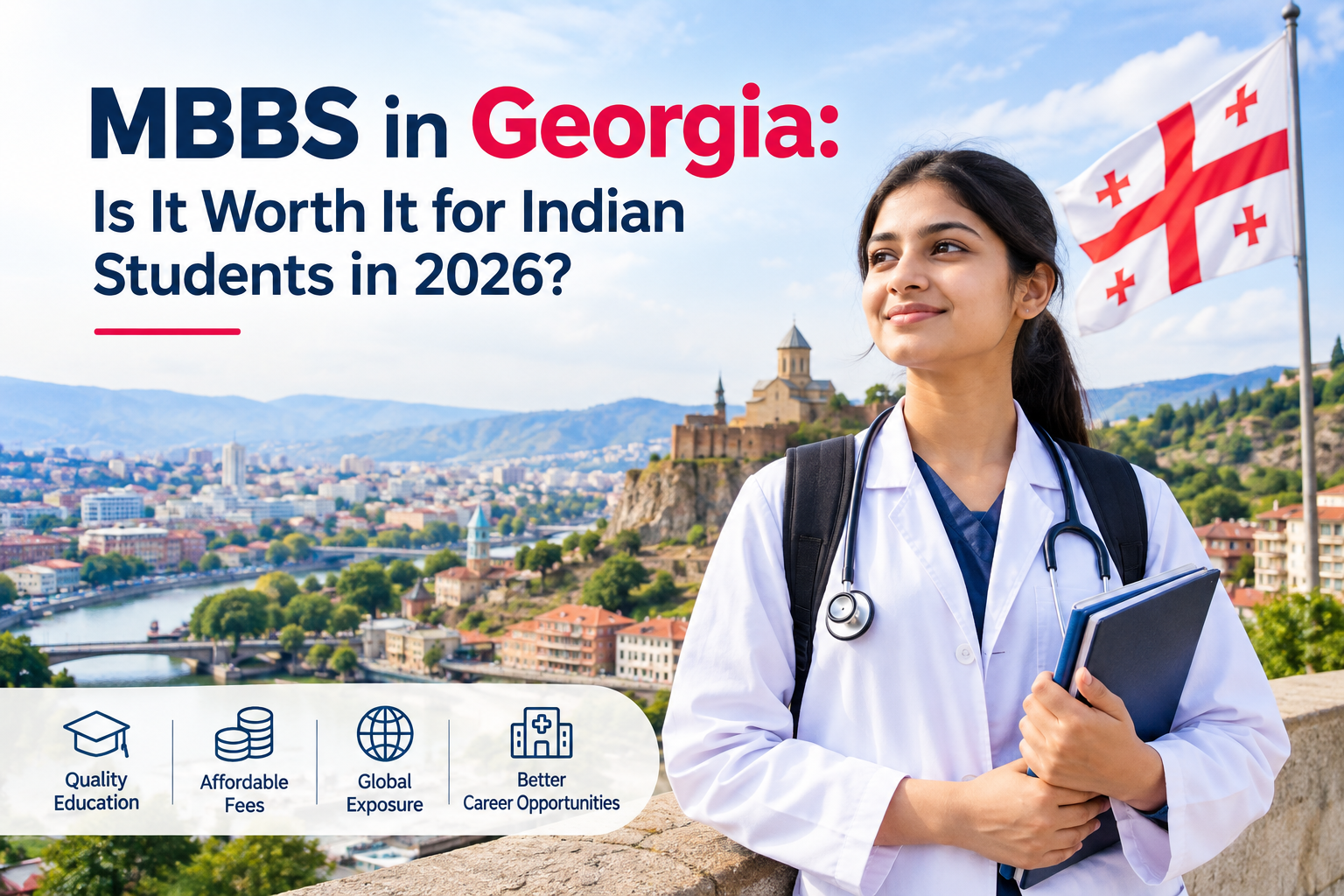
MBBS in Georgia is worth it for Indian students who have qualified NEET, can budget ₹30–55 lakh, and are ready to prepare seriously for the FMGE licensing exam. It is not worth it for students who see it as an easy route to an Indian medical licence.
Georgia is the country in the Caucasus, not the US state. Georgia is bordered by Russia, Turkey, Armenia and Azerbaijan. More than 10,000 Indian students are reported to study MBBS there. Here is what has changed in 2026 and what the numbers look like.
Quick facts: MBBS in Georgia for Indian students (2026–27)
- Tuition: USD 4,000 to 8,000 per year, depending on the university
- Total cost (6 years): Sources range from ₹30–40 lakh to ₹40–65 lakh depending on university and lifestyle
- NEET: Mandatory for Indian students who want to practise in India
- Language: English-medium
- Who can apply: Private universities only (see the 2026 change below)
- Licensing: You must clear the FMGE before you can practise in India
The 2026 change: Georgia’s state universities no longer admit foreign students
This is the most important update for 2026. In December 2025, Georgia’s Education Minister Givi Mikanadze announced that state universities would stop admitting foreign students, except in exceptional cases. That includes Tbilisi State Medical University (TSMU), which many older blogs still list as open.
The government noted that roughly 45% of TSMU’s students were foreign, a ratio it intends to reverse. The change applies to all international students, not only Indians. Private NMC-compliant universities such as Georgian American University, BAU International University, Georgian National University (SEU), Caucasus University, David Tvildiani Medical University and New Vision University remain open.
What this means for you: Any website still advertising TSMU admission for 2026–27 is out of date. Always confirm a university’s current status in writing before you pay anything.
How much does MBBS in Georgia cost in 2026?
Add the following, which most fee tables leave out:
- Flights, visa and insurance
- FMGE coaching, which is often ₹1–2 lakh or more
- A possible one-year gap if you need a second FMGE attempt
For comparison, a private MBBS seat in India is quoted at ₹50–80 lakh, and other sources put it as high as ₹1.2–2.5 crore. Georgia is clearly cheaper, but the saving is partly offset by the licensing exam.
NMC rules every Indian student must follow
India’s NMC sets the conditions under the Foreign Medical Graduate Licentiate (FMGL) Regulations, 2021. These apply to students admitted on or after 18 November 2021.
- The course must run at least 54 months, followed by 12 months of internship in the same foreign institution
- The degree must be taught in English and recognised by the foreign country’s regulator
- The entire course and internship must be done abroad at the same institution
- After returning, you complete another 12 months of supervised internship in India
- NEET qualification is required before admission
The minimum realistic timeline from Class 12 to independent practice in India is about 8 years. This includes the 54-month course, the 12-month internship, FMGE preparation and the Indian internship.
The FMGE reality check
Every Indian student who graduates abroad must clear the FMGE. The national numbers are sobering:
- January 2026: 11,160 of 43,933 candidates qualified, a pass rate of 25.40%
- June 2026: Only 4,635 of 36,280 candidates qualified, around 12.8%. Other outlets report 12.4% using a slightly different candidate count
- First-timers do much better: 35.74% of first-time candidates cleared the June 2026 exam, against 21.45% of second-timers and 3.29% of those with more than five attempts
- So the cost of delay is real. The first attempt matters most.
What about Georgia-specific pass rates? Published figures vary widely. One consultancy compilation reports a 35.65% FMGE pass rate for Georgian graduates in 2024, from 4,221 candidates. Other sites quote anywhere from 10% to 45%. Treat all university-wise percentages as indicative, since NBEMS does not publish official university rankings. Ask any university for its latest verified numbers and for the names of recent graduates you can contact.
What about NExT? The National Exit Test was meant to replace the FMGE, but it is reported to be deferred, with NExT Step 1 scheduled for February 2028. For now, plan for the FMGE.
MBBS in Georgia: pros and cons
Pros
- Much lower total cost than Indian private colleges
- English-medium teaching, with no IELTS or TOEFL
- Safe, student-friendly environment with a climate familiar to Indians
- Western-style, clinically oriented curriculum
- Large Indian student community and mess facilities
Cons
- State universities are now closed, which reduces choice and some price advantage
- The FMGE pass rate is low nationally, and Georgia is not exempt
- The full path takes 8+ years
- Fees rise if you need extra FMGE attempts
- Quality varies sharply between private universities
Who should choose MBBS in Georgia?
It is a good fit if you:
- Have qualified NEET but missed an Indian government or affordable private seat
- Have a realistic budget of ₹30–55 lakh
- Are disciplined enough to study for the FMGE from year 3 or 4
- Are comfortable living abroad for 6 years
Think twice if you:
- Have not qualified NEET (you cannot get an Indian licence later)
- Expect guaranteed licensing
- Would have to take large loans with no fallback plan
Georgia vs other MBBS abroad destinations
Georgia is generally priced mid-range: more expensive than Kyrgyzstan or Kazakhstan, cheaper than most Western options. Compare Georgia with Russia, Kazakhstan, Uzbekistan and others on our offered universities page.
How to choose a safe Georgian university: 6-point checklist
- Listed in the WHO World Directory of Medical Schools (WDOMS)
- Program is at least 54 months, English-medium and recognised by Georgia’s regulator
- Open to international students for 2026–27 (confirm in writing)
- Own teaching hospital or clear clinical training partnership
- Transparent, verifiable FMGE results and a structured internship plan
- A fee agreement with no hidden charges, and refund terms in writing
Remember that the NMC does not approve or endorse individual foreign universities. “NMC approved” on a brochure is a marketing phrase. What counts is whether the university and course meet NMC criteria.
Final verdict
MBBS in Georgia is worth it as a calculated decision, not as a shortcut. The cost advantage is real, but so is the licensing risk. Students who choose a verified private university, start FMGE preparation early and keep a financial buffer have a realistic path to practising in India.
Planning MBBS in Georgia? United Studies Abroad Consultants offers admission counselling, university shortlisting, education loan assistance and forex support. Contact our Nagpur team for a profile review before you apply.
FAQs
- Is MBBS in Georgia worth it for Indian students in 2026?
Yes, if you have qualified NEET, can budget about ₹30–55 lakh, and will prepare seriously for the FMGE. It is not worth it if you expect an automatic Indian licence. - How much does MBBS in Georgia cost for Indian students?
Tuition is roughly 4,000–8,000 per year. The full 6-year cost is typically ₹30–55 lakh including hostel and living expenses. Some sources quote up to ₹65 lakh for premium private universities. - Is NEET compulsory for MBBS in Georgia?
Yes. Indian students must qualify NEET to be eligible for the FMGE and practise in India. Your site’s own FAQ states the same. - Is an MBBS degree from Georgia valid in India?
Yes, if the university is WDOMS-listed, the course meets NMC’s FMGL rules (54 months plus 12 months internship, English-medium), and you clear the FMGE and complete an Indian internship. - Can Indian students still join Tbilisi State Medical University in 2026?
No. Georgia’s state universities, including TSMU, stopped admitting new international students from 2026–27. Private NMC-compliant universities remain open. - What is the FMGE pass rate for Georgia MBBS graduates?
Georgia-specific figures vary by source, roughly 10–45%. Nationally, the pass rate was 25.40% in January 2026 and about 12–13% in June 2026. Always verify with the university and NBEMS. - How long does it take to practise in India after MBBS in Georgia?
Around 8 years minimum: a 54-month course, 12-month internship abroad, FMGE preparation, and a 12-month internship in India. - Is Georgia safe for Indian students?
Georgia is generally regarded as safe and student-friendly, with low crime in major student cities such as Tbilisi and Batumi. Choose university-managed or verified hostels. - Is MBBS in Georgia better than MBBS in Russia or Kazakhstan?
It depends on budget and goals. Georgia is mid-priced with English-medium instruction. Kyrgyzstan and Kazakhstan are cheaper; Russia has long-established medical universities. Compare the full cost and FMGE support, not only tuition.